

Why the Advantage Isn't Just the Model
There is a version of the AI conversation that treats access to the best model as the finish line. Pick the frontier model, wire it into the product, and the advantage follows. That framing is comfortable, and it can be very wrong. Access to capable models is becoming a commodity. Almost everyone building software today can reach the same handful of providers. What separates the companies that pull ahead is not the model, it is the context they bring to it.
That distinction sits at the center of how we think about AI across Andromeda.
We operate mission-critical vertical market software companies around the world. The durable source of advantage is the domain-specific records, customer history, and workflow context that a business accumulates over years of serving a single vertical. For a portfolio of vertical market software businesses, that asset is already on the balance sheet. Each of our companies sits on deep, structured, domain-specific data generated by mission-critical workflows that customers run every day. We do not have to acquire context, manufacture it, or rent it. We have spent years, in many cases decades, accumulating it inside the systems of record our customers depend on. The value comes from leveraging and fine tuning the two: capable models, applied to data and context that competitors cannot easily reproduce.
That advantage is real, but it is not automatic. Decades of operating data is not the same thing as data a model can actually use. In most businesses that history is spread across aging systems, trapped in formats no one designed for analysis, governed by contracts that never anticipated AI, and shaped by workflows that were built for people rather than machines. Before any of it becomes an advantage, it has to be made ready: consolidated, structured, accessible, and cleared for use. This is why technology modernization and data readiness are not a side project to the AI work.
This is also why our AI work is not a pilot program waiting for results. It is already operating inside our businesses. The discipline we are focused on now is making it repeatable across the portfolio rather than letting it live in one strong corner of one company. When a business unit figures out how to apply AI to due diligence, customer support, or product planning, the question we ask is how that becomes a pattern other companies in our portfolios can reuse, adapted to their own vertical and their own data.
Two things make that repeatable. The first is that AI is not the property of any one function. The most durable gains we see do not come from a single AI team shipping a single feature. They come from product, support, sales, finance, and operations each applying the same underlying capability to the problems they know best. Enablement, done well, puts the capability in the hands of the people closest to the work and lets the use cases come to them. The second is that this spreads through people, not generic mandates. It moves through the operators, general managers, and internal champions who already carry credibility inside their businesses, rather than through a central stack handed down from above. Our role is to connect those people, surface what is working, and lower the cost of the next team adopting it.
Ashley Chiu, our VP of AI Enablement, puts it this way: "The opportunity is not to adopt AI as a set of tools, but to treat it as an operating-model decision and build a system of enablement to extend an advantage we already hold. That is why we are building toward portfolio-level repeatability: a platform and a shared set of patterns that turn one company's breakthrough into something every business can reuse. Done well, that converts each business's individual edge into a compounding, portfolio-wide one."
This is the same position Constellation Software has taken publicly. On its most recent earnings call, Constellation president Mark Miller addressed the noise in the market about AI disrupting software businesses by pointing to the deep customer relationships its subsidiaries hold, which let those businesses keep building products that meet client needs. Constellation has said its long-term differentiation will come from domain expertise, customer relationships, and data assets rather than from building product features faster. The adoption is already broad across the group. As of a recent investor update, a little over a quarter of business units were developing AI-powered products for their customers, half were applying AI to sales and marketing, and roughly six in ten were using AI tools in R&D. That is the operating context we sit inside, and it matches what we see in our own businesses.
We recently spent two days with Microsoft going deep on exactly this set of questions, and the most useful part of the conversation reinforced where we were already pointed. The strongest source of durable advantage in AI is proprietary context, not generic model access. Companies pull ahead when they understand which of their data assets are scarce, defensible, and reusable, and treat that scarcity as the strategy.
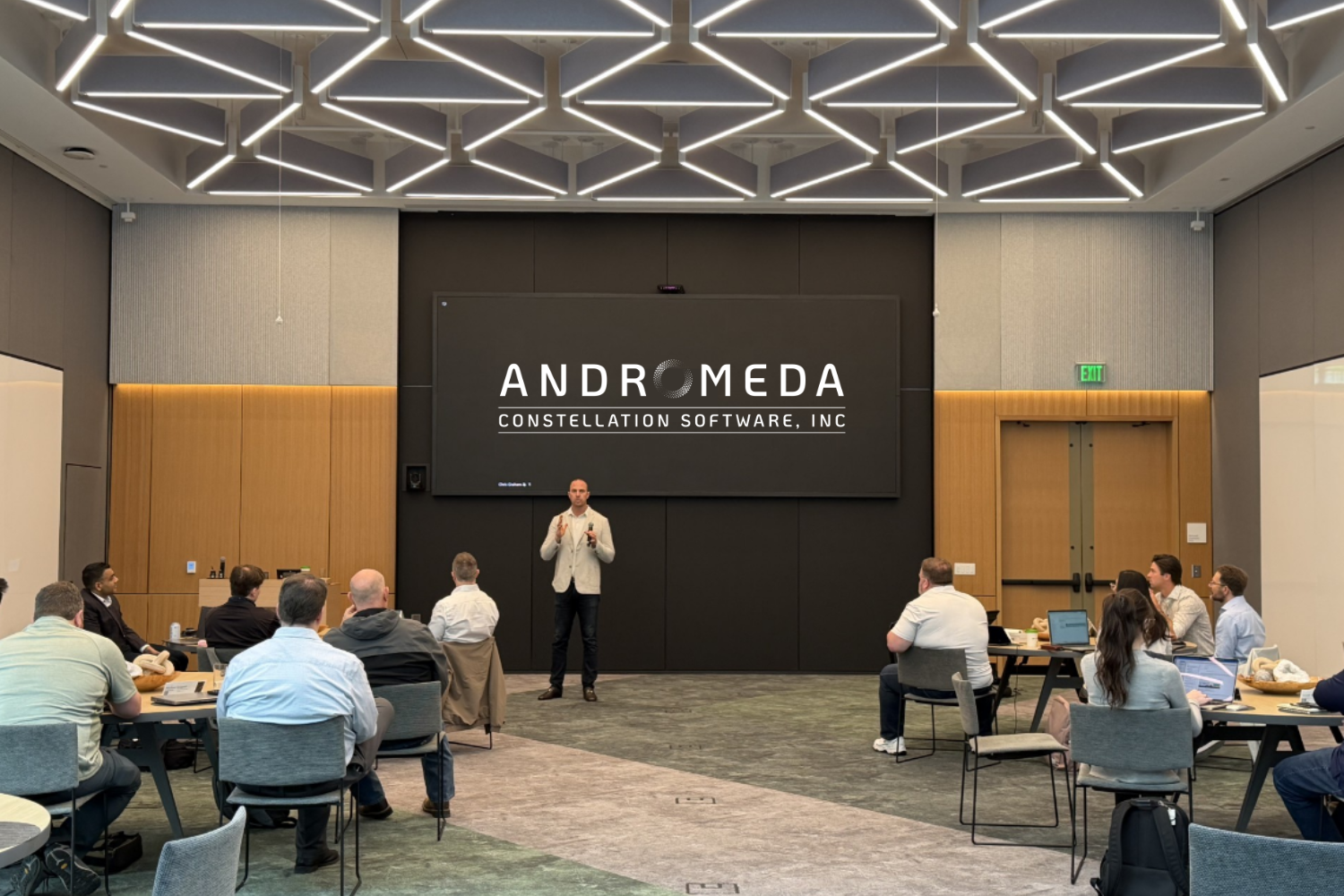
Microsoft x Andromeda x Perseus - AI Executive Briefing
That is a clarifying way to look at every business we hold, and it sharpens the harder questions, which are less about technology and more about judgment. Which of our data assets create durable advantage, and which just feel valuable? Where is it worth building proprietary capability, and where are we better off partnering so our teams stay focused on what only they can do? And how do we turn all of this into something measurable rather than something we talk about in a deck. Those are operating decisions and change management to enable true business transformation, and they are where most of the work lives.
There is one more question underneath those, and it is the one that ultimately decides whether any of this matters: what does the advantage produce? It is tempting to measure AI only by what it saves. Lower cost is real, and it is the easiest result to point to, but it is also the most quickly competed away. The more durable payoff is on the other side of the equation. The same proprietary context that makes a model useful internally is what lets a business build capabilities its customers will pay for: features competitors cannot copy because they lack the data behind them, products that move the company further into its customers' operations, and pricing that reflects new value rather than the same value delivered cheaper. In mission-critical software, that shows up as deeper usage, lower churn, and customers who expand what they buy over time. Cost efficiency funds the work. Revenue is what compounds. A business that uses AI only to do the old job for less has captured the smaller half of the opportunity.
"The test we hold ourselves to is simple," Chiu adds. "Efficiency keeps you in the game. New value your customers will pay for, and cannot easily get anywhere else, is what extends the moat."
For the companies inside our portfolio, this shapes how we think about support. AI is not a separate initiative competing with the core business for attention. It is a capability that strengthens businesses that already work. The companies we hold were acquired because they solve real problems for the industries they serve. AI gives their teams better tools to keep solving those problems, faster, at lower cost, and increasingly in ways that open new revenue, without asking them to become something they are not.
The reframe is simple to state and demanding to execute. The model is not the moat. The context is. But context only becomes a moat when a business is ready to use it, when the capability reaches every function rather than one, and when it produces value customers will pay for rather than savings alone. Our advantage is the decades of operating knowledge already sitting inside our businesses. The work is getting that knowledge ready, putting it in the hands of the people closest to the customer, and turning it into a capability we can apply, and monetize, consistently across every vertical and geography we serve.
That is the standard we are building toward.